
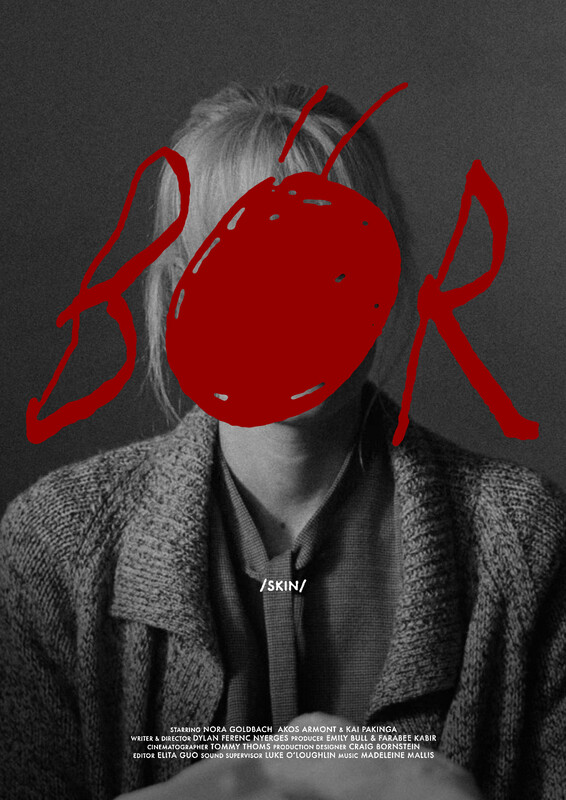
A Hungarian mother struggles to adapt to her new life in 1950s Australia as intense homesickness drives her further away from her young son and husband.

Bor
State
NSW
Genre
Drama
Duration
15:00
Key Cast
Nora Goldbach, Akos Armont, Kai Pakinga
Director
Dylan Ferenc Nyerges
Producer
Emily Bull
Screenwriter
Dylan Ferenc Nyerges
Executive Producer
Cinematographer
Tommy Thoms
Composer
Madeleine Mallis
Editor
Elita Guo
Director Biography.
Dylan Ferenc Nyerges is an Australian filmmaker and alumnus of the Master of Arts: Screen (Directing) program at the Australian Film Television and Radio School (AFTRS). Born and raised in Bangkok to Australian documentary filmmakers, Dylan moved to Australia to pursue filmmaking. His latest film, Bőr (Skin) is a period Australian Gothic Horror performed in Hungarian. Premiering the film at the 2024 Melbourne International Film Festival, Dylan was selected for the festival’s Director’s Lab (‘Accelerator Lab’) in addition to receiving the Award for Emerging Australian Filmmaker. The film was also awarded Best Short Film at the 2025 Byron Bay International Film Festival and the Golden Tripod for Student Cinematography at the 2025 ACS National Awards for Cinematography. Inspired by his paternal grandparents’ migration to Australia, as a result of the 1956 Hungarian Revolution, Bőr is a deeply personal endeavour and key stepping-stone in Dylan’s development as a filmmaker. He continues to grapple with his Third-Culture Identity and has interests that extend beyond cinema: global politics, philosophy, and theory - all in an effort to better utilise cinema’s formal considerations. In 2025, Dylan was awarded placement in the 'Leading Lights' initiative as part of the Australian International Documentary Conference (AIDC). Besides narrative filmmaking, he is currently interested in Experimental Video, Hybrid works, and is also currently developing projects set in Australia and Thailand. Alongside Directing, Dylan has worked in Post-Production. In 2020, he worked as a freelancer with The Post Lounge and was the First Assistant Editor for Lindy Chamberlain: The True Story (2020). Besides this, Dylan has worked as an Editor and is credited for 100+ episodes of television.
Director Statement.
My grandmother once told me that she had a recurring nightmare. She was lost and running through an empty city with no end in sight. Having been present when the shooting began, to mark the beginning of the 1956 Hungarian Revolution, it is not hard to imagine this experience planting roots into the labyrinth of one’s mind. I have long been obsessed with identity and its maze-like corridors. As we step through doorways and thresholds, from one ‘life chapter’ to the next, we accept a whirlwind of uncertainty and emotional vulnerability. While this can be an exciting opportunity for reinvention, a sudden loss of one’s bearings can spiral into disorientation - spiritual or otherwise. Having been born and raised to expats in Bangkok, I had the unique privilege of experiencing a sleepless city. It was a place of intermeshed levels of wealth that did not hide its effects on class, race, and gender. Despite being mindful of my otherness and eventual departure from Thailand, I arrived in Australia knowing nothing of its history. Like my grandmother, I was stepping onto foreign shores and began to question what ‘being home’ really meant, or where that home was meant to be. With Bőr, I feel as if I have unearthed something wicked and tonally-etched into my genetic being. It is a kind of lamentation - a dark, abject taint that speaks to a peculiar longing or nostalgia. It is also a thing of self disappointment, yet likewise a beautiful emancipatory discovery and a painfully genuine articulation of things I have felt so deeply for many years. This is a film that veers into being a magic-realist fairy-tale. It shifts between categories and is an amalgamation of many feelings, memories and observations. This elimination of boundaries hopefully speaks to those experiencing the cultural dissonance of not fully attributing oneself to national identities. Cracks within our sense of self may reveal these hidden perversions, sometimes full of melancholic guilt, which spread out and affect those we hold dear. When isolated, the family unit is a site that can breed wounds and deep scars. Anna and her family are an example of such, each suffering alone yet having to share space with the other. Having asked myself what part beauty may play in the aftermath of conflict, my hope is that we can treat some memories with tender care. With this medium, there is a power in its re-construction of events. Often, it has been known to re-create dreams. And with the past, mine or yours, such memories are like dreams, and to remember that we are its results. Sometimes we feel as if we change for better or worse. Change can force us to shed skin, leaving us vulnerable to the surrounding environment. Salvation may elude us in these moments of grief and loneliness, but there is hope in knowing that the sun will rise again, tomorrow, in the morning. For now, at least.
You might like these too.


PrincipAL Partner

major partner

GOVernment Partner

Gold Sponsor

corporate Sponsors



.png)


venue Partners


Sponsor

Poco Film Festival would like to Acknowledge the Traditional Custodians of the land we live and work on, the Wadawurrung and Dja Dja Wurrung People and recognise their continuing connection to the land and waterways, and pay my respects to their Elders past, present and emerging and extend this to all Aboriginal and Torres Strait Islander People.